The White Tiger: Arvind Adiga's first novel which landed him with the Booker Prize. Now i am not judge of the whether he deserves it or not nor am i judge of the novel's literary quotient. One thing for sure, its a hell of a novel. The novel portray's the dark side of India shining. It shows how people trapped in this "darkness" or "chicken coop" remain there forever; accept fate as it is. But this novel is more than that, its a story of those few "White Tigers" , who dream of the "light"; who want to move out of this "chicken coop" and eventually do breakout of it. That what makes this an interesting read. The unlikely rise of a entrepreneur, from being a normal taxi-driver in Delhi to owning an fleet of cars and running a taxi agency in Bangalore.
The style of writing is lucid and the pace is fast. The author describes the grim darkness very neatly, potraying the truth.
A lot of people have been turned off by this novel or say that its showing India in bad light; the reason they say so is because they haven't seen the "darkness" or witnessed someone fight out of this "darkness".
I won't go into the details of the story etc. Find out about it yourself.
The Lexus and the Olive Tree: Thoman Friedman's second book; a prequel to the world famous "The World is Flat" set in the pre-9/11 era. I picked up this book couple of times earlier, got bored; found it irrelevant and never went beyond a couple of chapters.
I picked this book again with an aim to finish it. The book suddenly turned out to be quite interesting, and very relevant in today's economic turmoil (Nope, doesn't give any insight into Raju's Books though) . This book tells us about how the foundation stones of current crisis were laid. Not only that it even predicts such a downturn as a possibility. If you want to know about Globalization; its roots; how it all began, then this is surely a good read. The stories and incidents that the author narrates are very interesting and fun to read. It talks about the pros, and cons of Globalization. Mostly pros though. Why some countries/people are against it or are even angry because of it. How most people in developing countries misunderstand "Globalization" for "Americanization" How companies/countries are adapting to it and so on. Sometimes though the book gets repetitive and boring; though overall the style of writing and his interactions with people world over make it worth a read.
Why the name, one might ask? The Lexus, Toyota's luxury brand denotes one end of the world where Globalization has been accepted while the Olive Tree represents the other extreme where people are fighting for gaining control over others' olive trees and protecting their own; where globalization treated as new word for US imperialism.
Q and A: Vikas Swarup, an Indian Diplomat's first novel. The story of an ordinary waiter who wins a million dollars on a KBC type quiz show. The producers think its a fraud. How can a waiter know the answers to tough General Knowledge questions. He says he just knows those answers. Not by luck, not by guessing. He just knew those answers. How did he know this answers, well thats what the book about. His life story; his experiences and his encounter with various type of people from which he came to know the answers to the GK questions. The book has similar undertones as the White Tiger about Dark India. What makes the book different is that ; although the certain description of people and places are life like, overall its pure fiction with twists and turns and a stunning ending. Yes, fit to be made into an movie.
The movie is already made. This book inspired the multi-award winning "Slumdog Millionaire" movie. The book again is fast paced and the style of writing easy. The author has focused on the characters and their emotions and less on the surrounding and the situation, making it a quick read.
Incase you are looking for some action on a lazy Sunday afternoon; chuck the TV and pick up this thriller.
Wednesday, January 14, 2009
Book Reviews: Tigers, Lexus and more


Thursday, December 13, 2007
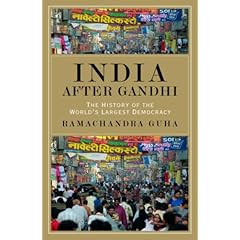
India After Gandhi .
At first i was sceptical of picking up this book, as i wasn't sure of the author.
I had seen Ramachandra Guha mostly of NDTV Big Fight; nothing beyond that.
A bit sceptical at first ; I picked the book anyways.
One of the first things i noticed is that the author had done extensive research; he knows what he is talking about.
So What is this book about anyways ?
As the title mentions its About India after Independence, after Gandhi.
As Guha has rightly pointed out, in schools history ends with our independence.
It may extend uptil Liberation of Hyderabad and Goa, but nothing beyond that.
Also the history i have read during school were prejudiced towards the Indian Government.
Well in the end who publishes those books.
Coming back to the main point, History for us in true sense begins after Independence.
1950s-60s were infact one of the most tumultuous periods of Free India and what most of the pages of the book talk about.
There were many issues Kashmir Independence, Naga problem, Reorganization of states based on Languages, Demands for New states,The wars against Pakistan and China,Famines/ Rise of Naxalites, Refugees inflow from Bangladesh[ formerly East Pakistan] etc etc.
We are taken through all these times and gives views of what Nehru, Vallabhbhai Patel and Other Eminent leaders thought and did. There is also views/opinions expressed by foreign media/reporters.
This really is very insightful into understanding how the nation has shaped up after some many years and also understanding views of other countries.
One of the points i personally really appreciate about Guha is that he never tries to provide his judgement/views because as he says, which is rightly so that he wasn't there then and neither is he an expert in state-affairs.
Also, standing out is the author's unbiased attitude. This is true, especially when it comes to the Kashmir Issue.
In the books/articles that i have read ,there is always a bias ;either criticizing the Indian Government or praising it.
There is never a part in the book, where there is either repetition or of being monotonous.
Towards the end, there is nice small chapter dedicated to Indian Entertainment which is obviously Movies and Sports, how that also influences our culture.
I would surely recommend this book to everyone who has prejudices regarding India and our past leaders.
Monday, April 02, 2007
Bombay trilogy !!
I have finished reading Suketu Bhatt's Maximum City. In some sense the trilogy is complete. Shantaram by Gregory David Roberts, Sacred Games by Vikram Chandra and now Maximum City. Its all about one thing and one thing only Bombay or Mumbai.
All authors give us a glimpse of this Country within a City . A nation state where despite all its problems people from every corner of India come in search of fulfilling their dreams.
Shantaram is the author's story. He is escaped convict from Australia . Here we learn about Slums , people living in it, their dreams and aspirations. We understand how foreign national people here survive forever. We learn all the illegal business conducted by the mafia.
Sacred Games is a fictional story about a Mumbai cop and a underworld mafia don. We see Mumbai through the eyes of these and more characters. We get the glimpse of the underworld , wars among various companies. How the cops are all integrated into this. How each cop works for either of these companies.
Maximum City is a first person, non fiction story where the author meets all sorts of people . People involved in killing muslims in the riots, people who are shooters for the mafia, gangsters, bar girls, bollywood people,politicians, business men et al.
I have learnt that there are two cities Mumbai for the Maharashtraians , for Shiv Sena and Bombay(Bambayie) for the cosmopolitan,the “other state” people doing business; how these two worlds clash and it can get bloody at times. But when it comes to Business , it doesnot matter whether you are in Mumbai or Bombay, whether you are a Hindu , Muslim , Sikh or Christian. Its just business as usual.
I learn that , there is nothing right or wrong. We all live in the grey area . Thats what Bombay teaches .
Friday, February 23, 2007
Shantaram
Long back I read a book Shantaram by Gregory David Roberts . It follows the life of a convict escaped from Australia living in the slums of Mumbai. Living there he sets up a free clinic. He also joins to Mumbai mafia , gets involved into smuggling , drugs etc. He also forges passports. He works in Movies . He helps agents get find actors. He also joins the Mujahudeens in Afghanistan .
He has a mentor Khader Bhai . The conversations between the two is food for thought . The philosophy behind this story is great. The descriptions of characters and pace of this semi autobiography is really good. It gives peek into Mumbai, life in the slums and mafia there.
All in all , the characters described and their stories are surreal. Worth a read to find out different ways of life people lead.

Thursday, February 22, 2007
Butter Chicken in Ludhiana
I just finished reading Butter Chicken in Ludhiana by Pankaj Mishra.
The author narrates his journey throughout small towns in India , from North to the South. It really gives a picture of how things in small town India has changed over the years.It also gives an idea of how attitude of people has changed . He travels from states of Bihar , UP to Rajashtan . He moves to the South close to Bangalore . Along this long journey he narrates some really good stories related cultural clashes, generation gaps and politics.
A must read for anyone interested to know about India